
AI-Powered Facility Management in Educational Institutions
Managing educational institutions is a complex task that involves maintaining infrastructure, ensuring security, optimizing energy consumption and efficiently utilizing available space. With multiple buildings, classrooms, laboratories, libraries and recreational areas to oversee, institutions often face challenges in keeping their facilities functional, safe and cost-effective.
Traditional facility management relies on manual processes, reactive maintenance and inefficient resource allocation leading to high costs, delays and operational inefficiencies. However, advancements in Artificial Intelligence (AI) and smart solutions are transforming facility management allowing educational institutions to automate processes, improve efficiency and enhance security and sustainability.
This blog explores how AI-powered smart solutions are reshaping facility management in educational institutions and the benefits they offer.
Challenges in Traditional Facility Management
Educational institutions often face several facility management challenges that impact efficiency and cost-effectiveness.
One major issue is high maintenance costs due to reactive approaches where problems are addressed only after they become severe. This leads to unexpected breakdowns, costly emergency repairs and disrupted operations. Preventative measures are often overlooked resulting in excessive long-term expenses.
Energy inefficiency is another concern. Institutions consume large amounts of electricity for lighting, heating, ventilation and air conditioning (HVAC) systems. Without AI-driven automation, energy use is often unregulated leading to waste and inflated utility bills.
Security concerns also remain a priority. Traditional security systems depend heavily on manual monitoring and human intervention which can be slow and unreliable. Unauthorized access, vandalism and theft remain risks particularly on large campuses.
Additionally, many institutions still rely on manual paper-based processes for facility management tasks such as maintenance tracking, work orders and security logs. These outdated methods cause delays, miscommunication and inefficiencies.
Space utilization is another challenge. Without proper management, classrooms and other facilities may be underused or overcrowded leading to scheduling conflicts and inefficient resource allocation.
How AI is Transforming Facility Management in Educational Institutions
AI is revolutionizing how educational institutions manage their facilities by automating tasks, improving efficiency and optimizing resource utilization.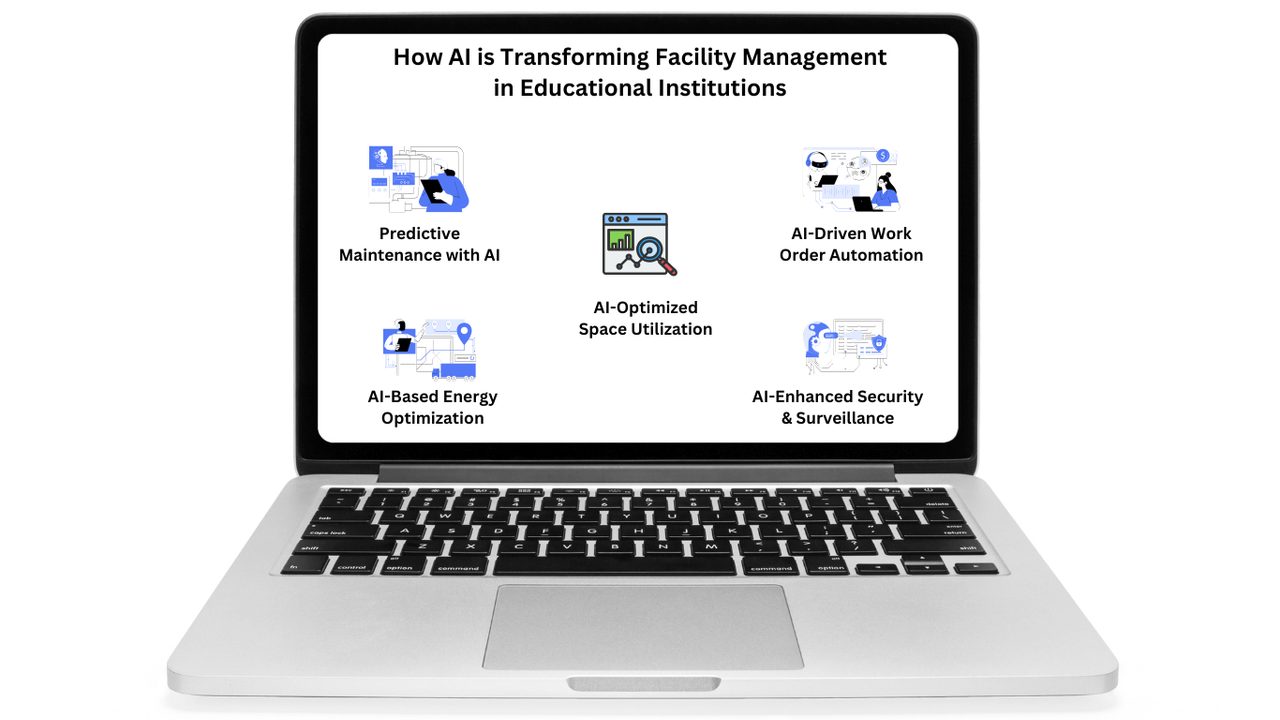
Predictive Maintenance with AI
AI-powered predictive maintenance allows institutions to anticipate equipment failures before they occur. By analyzing data from HVAC systems, electrical grids and plumbing networks AI can detect early signs of malfunctions and schedule maintenance proactively.
This shift from reactive to predictive maintenance reduces downtime, prevents costly emergency repairs and extends the lifespan of critical infrastructure. Maintenance teams can focus on addressing potential issues before they escalate resulting in smoother campus operations.
AI-Based Energy Optimization
AI-driven energy management systems analyze usage patterns and adjust settings in real time. By integrating IoT sensors with AI algorithms institutions can automatically regulate lighting, heating and cooling based on occupancy levels and external weather conditions.
This leads to substantial energy savings by eliminating unnecessary consumption. Smart meters provide real-time energy insights allowing institutions to make data-driven decisions and contribute to sustainability efforts.
AI-Enhanced Security & Surveillance
AI-powered security systems enhance campus safety by providing real-time monitoring and automated threat detection. Facial recognition technology and biometric access control restrict unauthorized entry ensuring that only approved individuals can access sensitive areas.
Advanced surveillance systems use AI to analyze video feeds, detect unusual activity and send instant alerts to security teams. This reduces reliance on human guards and ensures faster responses to potential threats. AI can also integrate with emergency response systems automating alerts and evacuation protocols in critical situations.
AI-Driven Work Order Automation
Managing facility issues efficiently is crucial for smooth campus operations. AI-powered work order systems streamline maintenance requests by automatically categorizing and prioritizing issues.
Students and faculty can report facility problems through AI chatbots which instantly log the request and assign it to the appropriate team. AI also analyzes past maintenance data to optimize scheduling and resource allocation ensuring that urgent repairs are addressed promptly.
AI-Optimized Space Utilization
Effective space management is essential for institutions to maximize the use of classrooms, meeting rooms and other facilities. AI analyzes student schedules, attendance patterns and real-time occupancy data to optimize space allocation.
Smart scheduling tools prevent double bookings and ensure that resources are used efficiently. Institutions can also use AI-driven insights to plan future expansions and renovations based on actual usage trends.
The Benefits of AI-Powered Facility Management
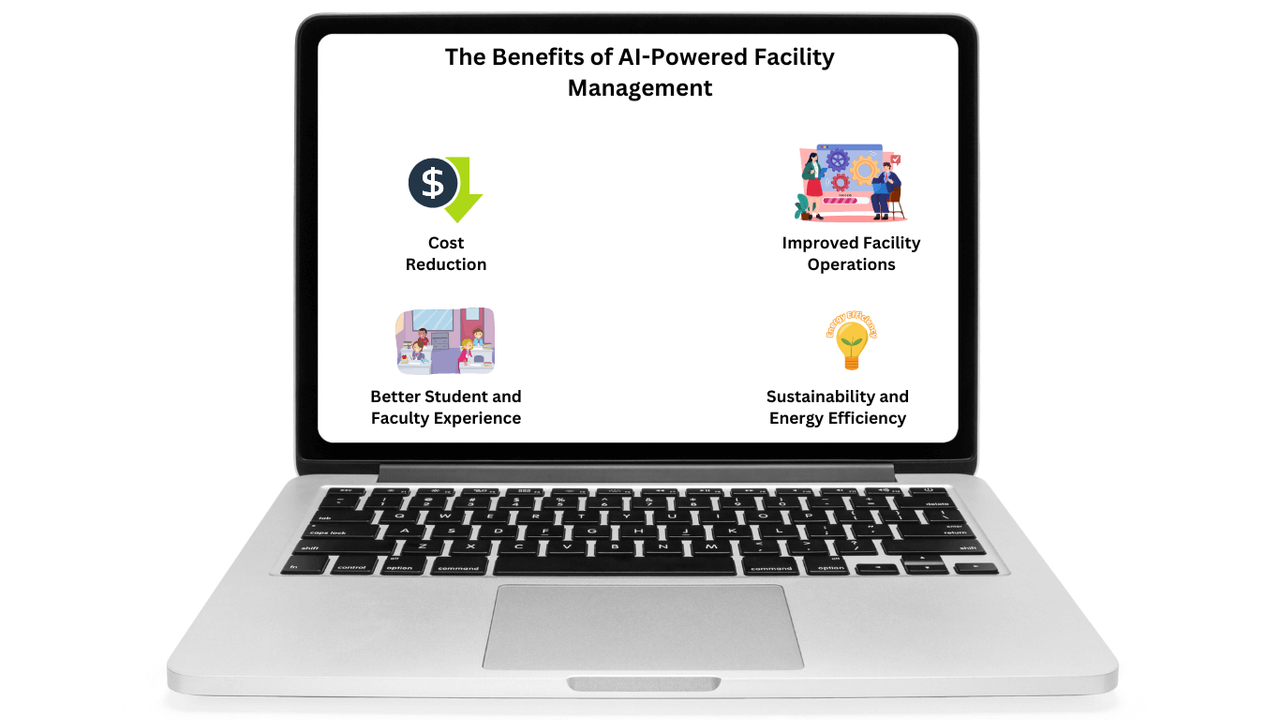
Cost Reduction
AI-driven predictive maintenance and energy optimization significantly reduce operational costs. Preventing unexpected equipment failures minimizes repair expenses while automated energy management lowers electricity bills. Institutions can redirect these savings toward academic programs and infrastructure improvements.
Enhanced Security
AI-powered surveillance and biometric access control enhance campus security by providing real-time monitoring and automated alerts. Security risks are detected faster reducing the chances of unauthorized access or potential threats. Institutions can ensure a safer environment for students, faculty and staff.
Sustainability and Energy Efficiency
AI helps institutions meet sustainability goals by optimizing energy use and reducing waste. Smart energy management lowers carbon emissions and contributes to environmentally friendly campus initiatives. Institutions can also track energy usage patterns to make informed decisions about sustainability improvements.
Improved Facility Operations
By automating maintenance tracking, work orders and resource management AI eliminates inefficiencies caused by manual processes. Facility teams can respond faster to issues, reduce paperwork and improve overall campus functionality.
Better Student and Faculty Experience
AI-powered facility management ensures a comfortable and productive learning environment. Optimized space utilization, smart temperature control and automated lighting adjustments create better classroom conditions improving student focus and engagement.
Real-World Applications of AI in Facility Management
Several educational institutions have successfully integrated AI-driven facility management solutions to improve efficiency and reduce cost.
Harvard University has implemented AI-based predictive maintenance to prevent unexpected equipment failures reducing operational costs.
Stanford University uses AI-driven biometric access control and surveillance to enhance campus security ensuring only authorized personnel can enter restricted areas.
MIT has optimized energy consumption with AI-powered automation significantly reducing its electricity usage and advancing its sustainability goals.
These real-world applications demonstrate how AI can transform educational facility management making campuses smarter and more efficient.
Implementing AI-Driven Facility Management
To successfully integrate AI into facility management institutions should start by conducting a comprehensive facility audit to assess current challenges and identify areas for improvement.
Selecting AI solutions that align with institutional needs is crucial. Whether implementing predictive maintenance, smart energy management, AI-powered security or automated space utilization institutions should prioritize solutions that address their specific challenges.
Training facility teams and staff on AI system usage ensures a smooth transition. Familiarizing teams with AI-driven insights and automated workflows helps maximize efficiency and improve decision-making.
Continuous monitoring and optimization are essential for long-term success. Institutions should regularly analyze AI-generated insights, adjust strategies and upgrade systems as technology evolves.
AI is revolutionizing facility management in educational institutions enabling smarter, more efficient and cost-effective operations. Predictive maintenance prevents costly repairs, AI-driven energy management reduces consumption, smart security systems enhance campus safety and automated workflows improve overall efficiency.
By adopting AI-powered solutions educational institutions can create safer, more sustainable and future-ready campuses. As AI technology continues to advance its role in facility management will become even more essential shaping the way institutions operate for years to come.