
How AI-Powered Digital Facility Management is Revolutionizing Transportation Hubs
Transportation hubs—airports, train stations and bus terminals—are the backbone of global mobility, handling millions of passengers and cargo every day. Managing such large-scale infrastructure requires efficiency, safety and seamless coordination. However, traditional facility management methods often struggle to keep up with the increasing demands, leading to inefficiencies, delays and increased operational costs.
With the integration of Artificial Intelligence (AI) and digital facility management, transportation hubs are undergoing a revolutionary transformation. AI-driven automation, predictive analytics and IoT-enabled systems are optimizing operations, enhancing security and improving the passenger experience. This article explores how AI-powered digital facility management is reshaping transportation hubs and what the future holds for these critical infrastructures.
The Evolution of Facility Management in Transportation Hubs
Facility management in transportation has evolved from manual processes to AI-driven, data-centric solutions. Traditionally, facility teams relied on scheduled inspections and reactive maintenance, which often led to costly breakdowns and operational delays.
With the rise of AI and IoT, transportation hubs now use real-time monitoring, predictive analytics and automation to improve efficiency and reduce downtime. AI is analyzing vast amounts of data, allowing facility managers to make faster and smarter decisions while minimizing human intervention.
AI-Powered Technologies Driving Digital Facility Management
1. AI-Driven Predictive Maintenance
AI eliminates reactive maintenance by predicting when infrastructure components—such as escalators, HVAC systems and baggage handling systems—are likely to fail.
How It Works - AI algorithms analyze data from IoT sensors, historical maintenance logs and real-time performance metrics to identify potential issues before they occur.
Example - If an airport's baggage handling system shows signs of wear, AI-powered alerts notify maintenance teams before a failure disrupts operations.
Impact - Reduces downtime, prevents costly repairs and enhances passenger satisfaction.
2. AI-Powered Energy Management
Energy consumption is a major operational expense for transportation hubs. AI optimizes energy use by analyzing weather conditions, occupancy levels and historical energy patterns.
Example - AI-powered HVAC systems adjust heating and cooling based on real-time passenger density, reducing energy waste while maintaining comfort.
Impact - Lowers costs, improves sustainability and meets carbon reduction targets.
3. AI-Enabled Smart Security & Surveillance
Security is a top priority in transportation hubs. AI enhances safety through advanced surveillance, biometric access control and threat detection.
Facial Recognition - AI-powered cameras speed up security checks by verifying passengers’ identities.
Threat Detection - AI analyzes video feeds to detect unattended baggage, unauthorized access or suspicious behavior.
Example - At Dubai International Airport, AI-driven facial recognition speeds up passenger boarding while ensuring high security.
Impact - Faster processing times, improved security and reduced human errors.
4. AI for Passenger Flow Optimization
AI-powered analytics predict passenger traffic and recommend staffing, gate allocation and crowd control measures.
Example - AI at Tokyo Station analyzes train arrival times and foot traffic to optimize gate assignments, preventing overcrowding.
Impact - Reduces congestion, improves operational efficiency and enhances passenger experience.
5. AI-Powered Digital Twins
A Digital Twin is a virtual replica of a transportation hub that simulates real-time scenarios using AI.
Example - An airport simulates passenger flow during peak hours to determine optimal security screening layouts.
Impact - Helps facility managers make data-driven decisions, reducing bottlenecks and improving facility planning.
6. AI-Powered Chatbots & Virtual Assistants
AI chatbots assist passengers with real-time flight updates, navigation assistance and customer service inquiries.
Example - AI chatbots at Changi Airport provide live flight information, directions and baggage claim details via mobile apps.
Impact - Enhances passenger experience, reduces workload on staff and improves efficiency.
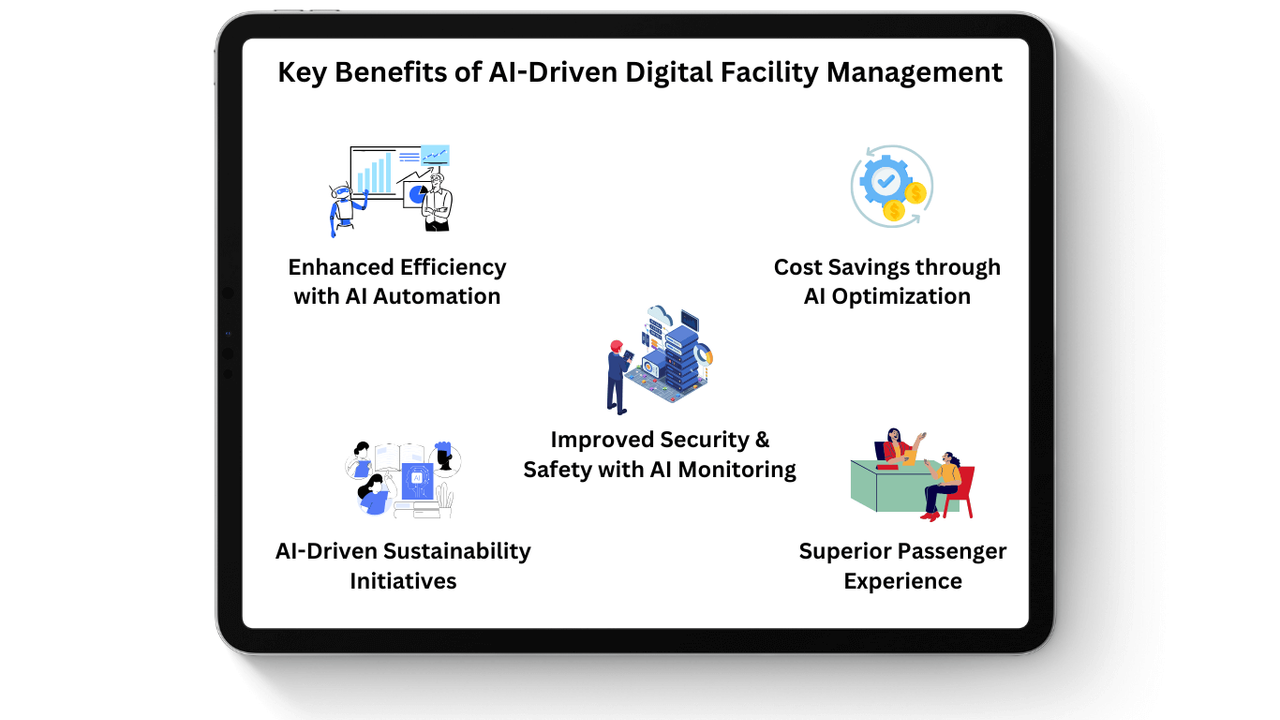
Key Benefits of AI-Driven Digital Facility Management
1. Enhanced Efficiency with AI Automation
AI eliminates manual inefficiencies by automating routine tasks such as maintenance scheduling, security monitoring and workforce management.
2. Cost Savings through AI Optimization
AI-driven energy management, predictive maintenance and workforce scheduling significantly reduce operational costs.
3. Improved Security & Safety with AI Monitoring
AI-powered surveillance and threat detection reduce risks by identifying potential security threats in real time.
4. AI-Driven Sustainability Initiatives
AI helps transportation hubs reduce their carbon footprint by optimizing energy consumption and waste management.
5. Superior Passenger Experience
AI-powered wayfinding systems, chatbots and predictive analytics improve passenger flow, reduce wait times and enhance travel convenience.
Real-World Applications of AI-Driven Digital Facility Management
1. AI in Smart Airports
Heathrow Airport uses AI to analyze passenger behavior and optimize security screening efficiency.
Singapore Changi Airport employs AI-powered chatbots to assist passengers with real-time flight information.
2. AI in Digitalized Train Stations
Tokyo Station uses AI to monitor crowd movement and adjust gate operations to prevent congestion.
Amsterdam Central Station integrates AI-powered predictive maintenance to minimize train delays.
3. AI in Smart Bus Terminals
Singapore’s bus network leverages AI for fleet management, real-time tracking and predictive maintenance.
AI-driven smart ticketing systems reduce waiting times and enhance travel efficiency